1,000
1,0000^n is 0 for values of n greater than 0.
n^0 is 1 for values of n other than 0.
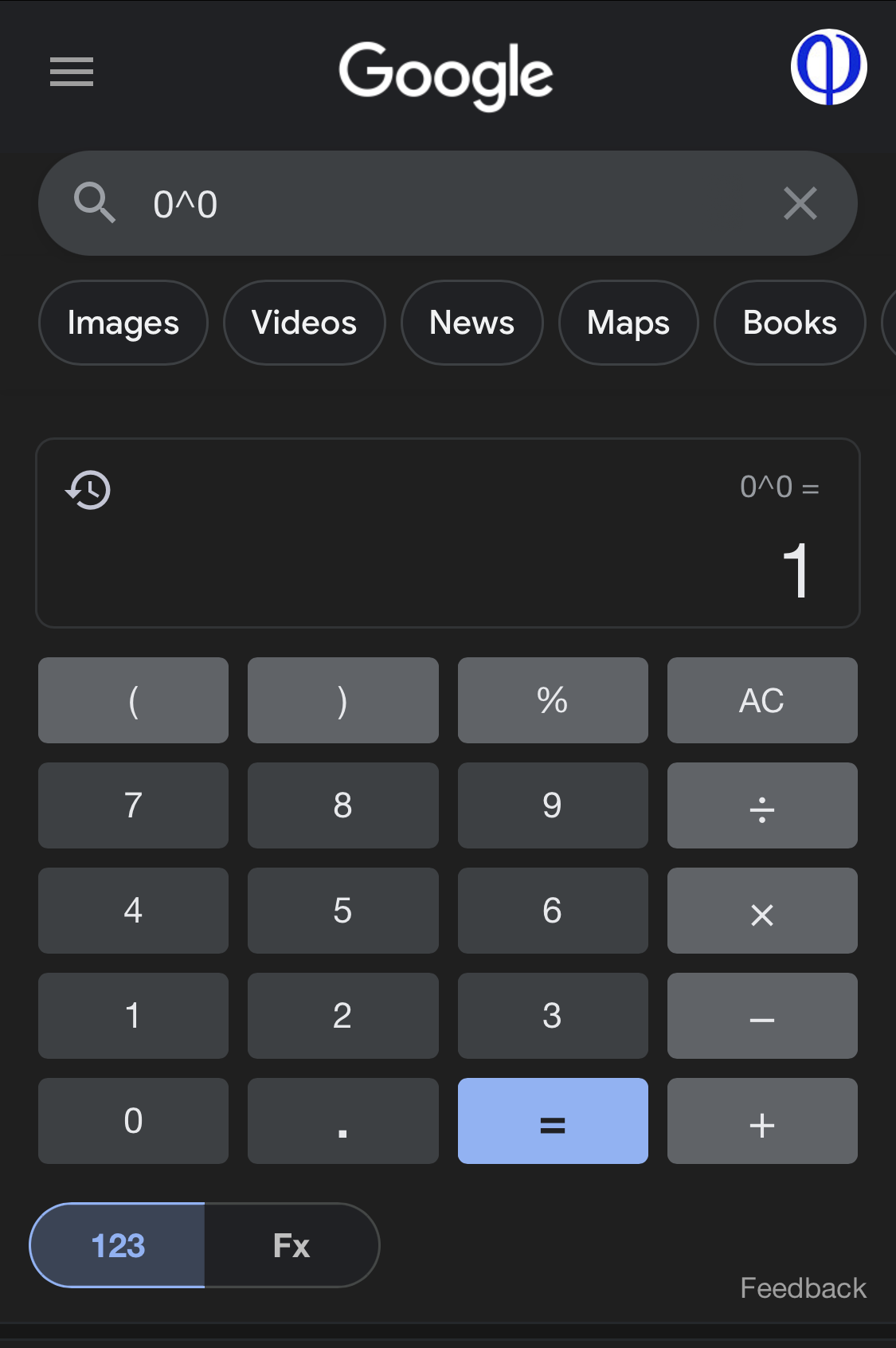
0^0 is undefined.
@tfae If you define 0^0 as the limit of 0^n as n goes to zero, then you get 0. Since you can define it in different ways to get different answers, the actual answer is (by definition) undefined. There's a wikipedia page on this https://en.wikipedia.org/wiki/Zero_to_the_power_of_zero which says "The choice whether to define 0^0 is based on convenience, not on correctness. If we refrain from defining 0^0, then certain assertions become unnecessarily awkward... The consensus is to use the definition 0^0 = 1, although there are textbooks that refrain from defining 0^0."
I take that to mean that 0^0 is obviously undefined, but it's useful to pretend that it has a value of 1. The article also says that some mathematicians go further and say that "0^0 has to be 1", but I regard that as obvious nonsense. It may be a useful fiction to pretend that it has a value of 1, but the actual value is clearly undefined.
@DanielParker All of mathematics is "useful fiction". I don't see that as a convincing argument.
The formalized math libraries in Coq and Lean show that it is consistent and useful to define everything. x / 0 = 0, and this is fine, because every theorem that would break under this assumption would take y ≠ 0 as a hypothesis, and many theorems actually don't break too. As for 0^0 = 1.
I take that to mean that 0^0 is obviously undefined, but it's useful to pretend that it has a value of 1.
This seems to misunderstand what a definition is. Definitions are not facts that we discover about the world, and there is no such thing as a correct or incorrect definition (except for definitions being correct insofar as they correspond to common usage). In the case of exponentiation, there are multiple distinct functions that can all be referred to as exponentiation. One is a partial function that does not take on a value at (0,0). Another is a function that takes on the value of 1. Both of these are real functions and perfectly well-defined. The question, "What is 0^0?" is equivalent to asking which of these functions the symbol ^ refers to. But it can refer to either depending on which convention you like best, so saying that 0^0 is "really" undefined and people who define it as 1 are just "pretending" is nonsense.
In calculus contexts, it's often desirable to have 0^0 undefined, because otherwise, exponentiation isn't a continuous function. But no one said we have to define exponentiation in a way that makes it continuous.