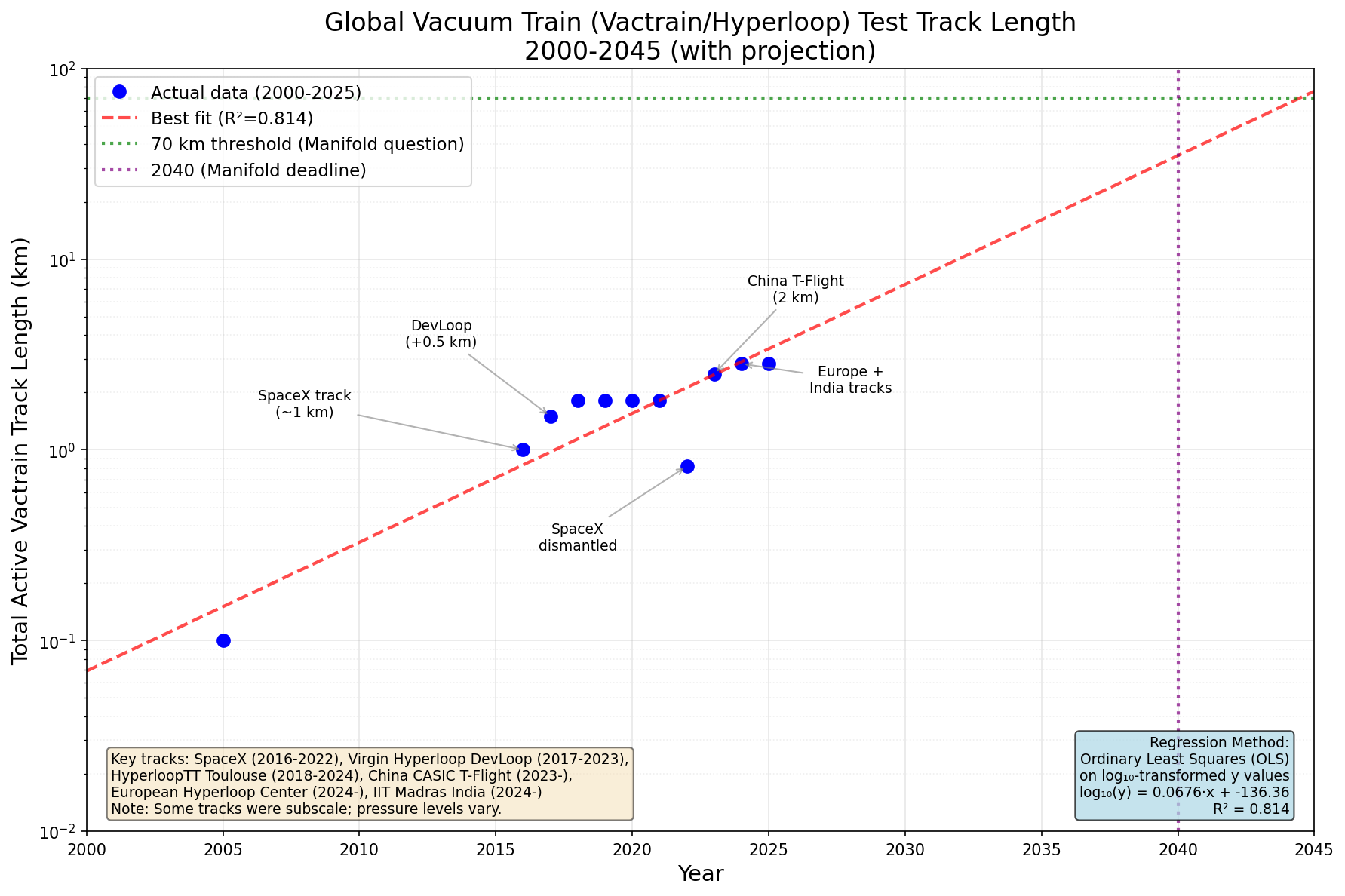
Resolves as YES if there is strong evidence that, at any time before January 1st 2040, the total length of active vactrain lines worldwide reached at least 70 route‑kilometers, under the definitions and criteria below.
What counts as a “vactrain”?
For this market, a vactrain is a ground‑based transport system where:
Vehicles travel inside a sealed tube or tunnel (above ground, at grade, or underground).
The tube is operated during motion at an absolute pressure of 0.1 bar or lower (≤ 10% of sea‑level atmospheric pressure).
Vehicles are designed as train‑like pods or carriages intended for human passengers or substantial freight, not toy models or tiny lab capsules.
Propulsion can be magnetic levitation, linear motors, air bearings, wheels, or any combination, as long as the vehicle’s primary travel is inside that low‑pressure tube.
Conventional high‑speed rail or maglev lines that run in normal air (e.g., Shanghai maglev) do not count. Systems that only slightly reduce pressure without entering a clear low‑vacuum regime also do not count.
What counts as a “vactrain line” and “route‑kilometers”?
A vactrain line for this question is:
A contiguous route of at least 1 km of vactrain tube/tunnel,
Built at full scale for human passengers or large freight (no 1:12 miniature loops, etc.),
And actually used by full‑scale vehicles in low‑pressure conditions.
For measuring distance, we use route‑kilometers:
Parallel tubes in opposite directions along the same alignment count once (e.g., a 60 km double‑tube test track is 60 route‑km, not 120).
Branches that diverge and rejoin only count their unique centerline distance (standard rail practice).
What counts as “active”?
A vactrain line is considered active if:
It has carried full‑scale vehicles in low‑pressure operation more than just a one‑off demo – e.g., repeated test campaigns over at least a few months, or scheduled commercial service.
It is in a state where it could reasonably be used again (not clearly abandoned, scrapped, or permanently depressurized).
Short‑lived pilot lines still count as long as there is clear documentation that they operated in vacuum/low‑pressure mode as described above.
How the 70 km total is calculated
For resolution, imagine summing up the maximum worldwide route‑kilometers of all qualifying vactrain lines that are simultaneously active at any moment before January 1st 2040.
If, for example, a 60 km national test track and a 3 km research track are both active at the same time, that’s 63 route‑km.
If another 10 km pilot line comes online later while those are still active, that would bring the total to 73 route‑km and this market would resolve YES.
If lines are decommissioned, that doesn’t matter as long as the peak combined total at some point in time reached ≥ 70 route‑km.
Resolution details
The market resolves YES if, before January 1st 2040, there is strong, publicly verifiable evidence (e.g., from government announcements, operators, credible news reports, academic or engineering publications, or official project documentation) that the worldwide total of active vactrain route‑kilometers, as defined above, reached 70 km or more at any point in time.
Otherwise, it resolves NO.
If there is borderline or ambiguous evidence (for example, unclear pressure levels, unclear line lengths, or disputes about whether a system is truly low‑vacuum), the resolver should use best judgement, err on the side of the explicit definitions above, and may consult community discussion before deciding.
 1,000
1,000